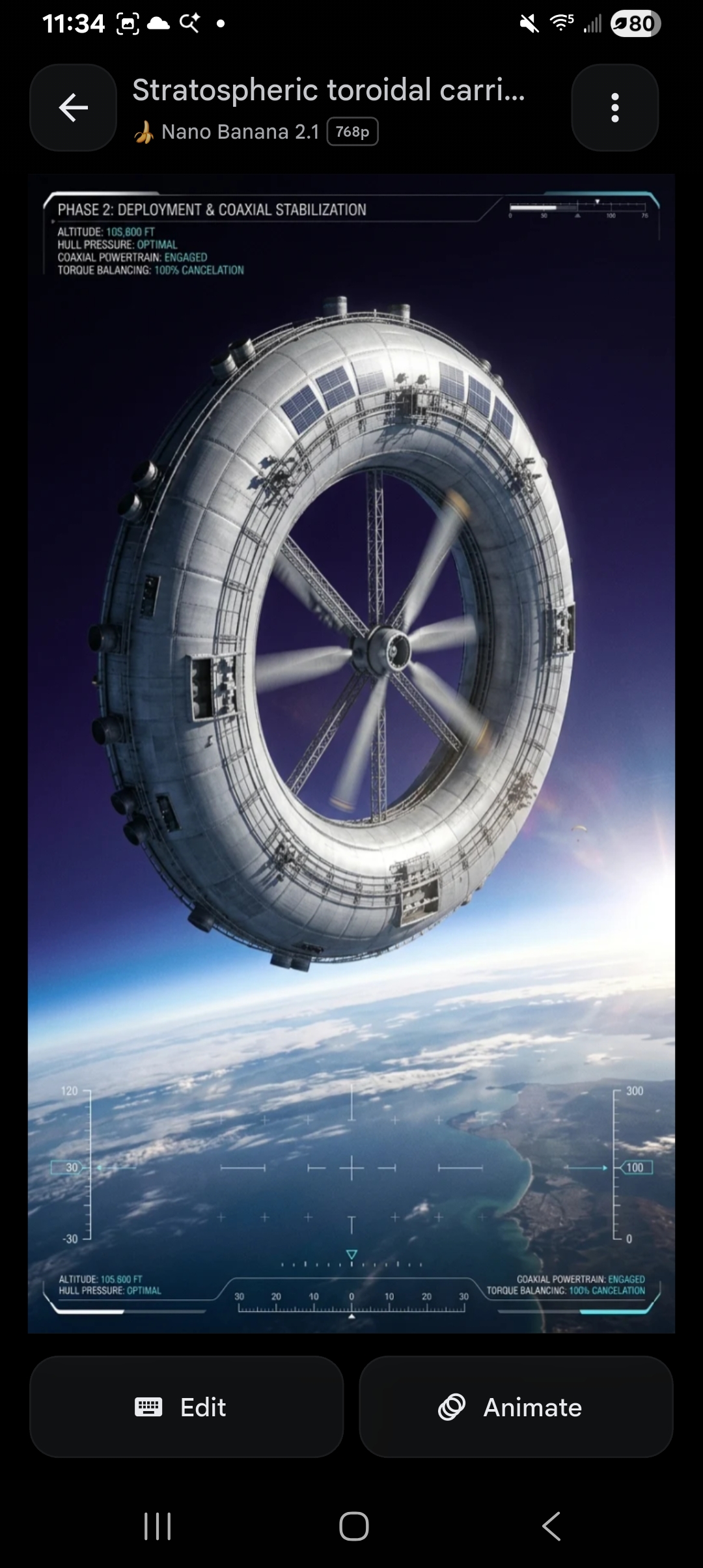
A 100-meter toroidal lighter-than-air platform stationed at
20 miles above the weather and the jet stream —
closer to the ground than any satellite. Zero-latency connectivity,
total airspace defense, and persistent power over one fixed point.
Today’s High-Altitude Platform Stations float as isolated units and hit a
wall: heavier payloads demand exponentially larger envelopes, a 20-mile
tether is crushed by its own weight, and the jet stream drags the
platform off station. The Space Shield answers each of those limits.
A rigid 1-meter-thick drop-stitch torus holds a fixed
geostationary position at roughly 20 miles (32 km) and carries
radar, communications, launch, and power payloads at once — a
stratospheric node in the gap between low-altitude drones and orbital
satellites.
Why 20 miles beats orbit
Sitting immediately above the ground beats being hundreds or thousands of
miles up. The inverse-square law works in the platform’s favor on power,
radar resolution, and latency alike.
AttributeLEO / GEO satelliteSpace Shield
Altitude300–750 mi (LEO) · 22,236 mi (GEO)20 mi — 15× to 1,000× closer
Latency25–45 ms (LEO) · 600± ms (GEO)< 1 ms, fiber speed
Radar & targetingAttenuated across hundreds of milesCrisp local line-of-sight; burns through jamming
Station-keepingOrbits at ~17,500 mph; drops offlineTrue geostationary over one point
MaintenanceNone — becomes space junkDrone-swapped in place, or lands for service
LaunchMulti-million-dollar orbital rocketsOn-demand local booster pod
How the Space Shield works
Structure, propulsion, radar, logistics — engineered to hold a hard
station in near-vacuum conditions and stay there.
01
Armored drop-stitch hull
Two composite skins woven with thousands of high-tensile threads form a
rigid 1-meter-thick wall — spaced-armor in effect. Shrapnel
is absorbed by the tension matrix, and the interior acts as thousands
of sealed micro-cells, so a puncture barely dents buoyancy.
02
Counter-rotating 50-meter blades
A single oxy-hydrogen internal-combustion engine drives a
coaxial planetary gearbox that splits torque into two 50-meter blade
arrays spinning in opposite directions — cancelling rotation with no
tail rotor, at roughly a 3 MW cruise.
03
Booster deployment
The torus travels deflated inside an aerodynamic shell, punched
vertically through the jet stream by a jet/rocket booster pod, then
inflates rigid in the 1%-pressure near-vacuum at 20 miles. The booster
is jettisoned and recovered.
04
Radar, launch cells, drone dock
AESA panels sit flat on the 360° rim for continuous,
no-moving-parts tracking; vertical launch tubes are woven into the
hull core; and UAVs launch and recover inside the wind-shadowed
central aperture.
05
Autonomous refueling loop
A logistics shuttle docks inside the donut hole and swaps
liquid hydrogen & oxygen up for the engine’s condensed exhaust
water down — a closed-loop mass balance that keeps the
platform locked at altitude indefinitely.
06
Daylight solar transition
The 100-meter top deck is lined with lightweight stratospheric
solar panels. Unfiltered sun runs the electronics by day and
idles the engine, stretching endurance from days to months.
By the numbers
Key figures from the provisional patent specification.
Operational altitude~20 mi / 32 km
Platform100 m toroidal drop-stitch
Hull wall1 m, compartmentalized
Lift blades2 × 50 m, counter-rotating
PowerplantOxy-hydrogen ICE · ~3 MW cruise
DeploymentJet/rocket booster · inflate at altitude
RefuelingLH₂/LOX · closed-loop water ballast
Network latency< 1 ms
Two configurations
A tethered elevator chain, or a free-flying toroidal carrier.
Tethered elevator chain
A daisy-chain of modular aerostats stacked in 1-mile segments
from a ground anchor to 20 miles. Each lifts only its own mass and one
segment of conduit carrying fiber, power, and gas. Mid-tier units in
the jet stream harvest aerodynamic energy from the wind.
Untethered toroidal carrier
The 100-meter drop-stitch donut with onboard oxy-hydrogen drive
and autonomous aerial refueling — no cable at all. Free to drift and
tilt to shed wind loads, deployed on demand, and recovered by a
controlled low-velocity vertical landing.
From the app
The Space Shield campaign, as it appears on a phone.
Space Shield · Patent Pending
Watch the shield
A short clip from the Space Shield campaign.
Space Shield · Patent Pending
Indefinite stratospheric dominance. Zero-latency connectivity. Total airspace defense.
Patent Pending. U.S. provisional patent application —
System and Method for a Multi-Tiered High-Altitude Stratospheric Platform
Elevator for Persistent Power Harvesting, Defensive Targeting, and
Telecommunications Broadcasting. Teleden LLC, 2026.